Bacteriostatic water
Sterile water with a preservative in it. The preservative is the entire reason the vial can be used more than once, and it is also where the 28-day number comes from.
Bacteriostatic water is sterile water for injection with 0.9 percent benzyl alcohol added as a preservative. That is the whole definition. It is not a different kind of water, it is not more sterile than sterile water, and it does nothing to the compound dissolved in it. The benzyl alcohol is bacteriostatic, meaning it stops bacteria from multiplying rather than killing them outright, and that single property is what makes a multi-dose vial possible.
The distinction matters because the three diluents people encounter are not interchangeable, and the differences are not about quality.
Bacteriostatic water, sterile water and saline
Sterile water for injection contains nothing but water. No preservative, no salt. It is packaged for single use, because once the stopper is punctured there is nothing in the vial preventing organisms introduced by the needle from growing. Preservative-free presentations are labelled single-dose for that reason.
Bacteriostatic water for injection is that same water plus 0.9 percent benzyl alcohol. The preservative is why the label permits multiple withdrawals from one vial rather than one.
Sodium chloride 0.9 percent, normal saline, is water with salt at roughly the concentration of blood plasma. It is isotonic, which bacteriostatic water is not. Saline also comes in both preservative-free and bacteriostatic presentations, and the bacteriostatic version uses the same benzyl alcohol. So "saline" on its own does not tell you whether the vial can be used more than once. The label does.
None of the three changes the compound. A diluent is a solvent. Choosing bacteriostatic water over sterile water does not make a preparation stronger, more stable, or more effective. It changes how many times the vial can be entered.
Where the 28 days actually comes from
Nearly every reconstitution guide, this site included, tells you to use a reconstituted vial within about 28 days when it has been mixed with bacteriostatic water. It is worth being precise about what that number is, because it is routinely misread.
The 28-day window is a property of the preservative, not of the compound. It reflects how long the benzyl alcohol can be relied on to hold bacterial growth in check across repeated punctures of the stopper. It is the conventional in-use limit for a preserved multi-dose vial, and it is the same 28 days whether the vial contains a peptide, a hormone, or anything else reconstituted the same way.
This cuts in both directions, and both are worth understanding.
A compound can degrade well before day 28. Peptide stability varies enormously by sequence, temperature, light exposure, and how many freeze-thaw cycles the vial has been through. Nothing about the preservative protects against any of that. For most research peptides there is no published stability study establishing a shelf life in solution at all, so "28 days" is filling a silence rather than answering the question.
And a compound can be perfectly stable past day 28 while the vial is still no longer appropriate to draw from, because the limit being reached is microbiological rather than chemical.
If you take one thing from this page: when a protocol says 28 days, it is quoting the diluent's in-use limit. If you want to know how long your specific compound lasts in solution, that is a separate question, and for many peptides the honest answer is that nobody has published it.
Benzyl alcohol, and the one population where it matters
Benzyl alcohol has a specific, documented safety issue that has nothing to do with peptides and everything to do with dose relative to body weight. In neonates, benzyl alcohol exposure has been associated with a toxic syndrome characterised by metabolic acidosis and respiratory distress, historically called gasping syndrome. Preserved diluents are therefore not used in newborns, and preservative-free presentations exist partly for that reason.
For adults the quantities involved in reconstituting a vial are small. The point of raising it is not alarm, it is that the preservative is a pharmacologically active ingredient rather than an inert one, and it is the reason "just use bacteriostatic water for everything" is not a rule.
What it does not do
- It does not sterilise anything. Bacteriostatic means it inhibits growth. A vial contaminated during handling does not become safe because the diluent is preserved.
- It does not extend how long the compound lasts. See above. Different question, different answer.
- It does not substitute for technique. The preservative is a margin against ordinary repeated access, not against a dirty stopper or a reused needle.
- It does not change the concentration. The volume you add sets the concentration, and the arithmetic is the same whichever diluent is in the syringe. The reconstitution calculator works identically either way.
Where this shows up in practice
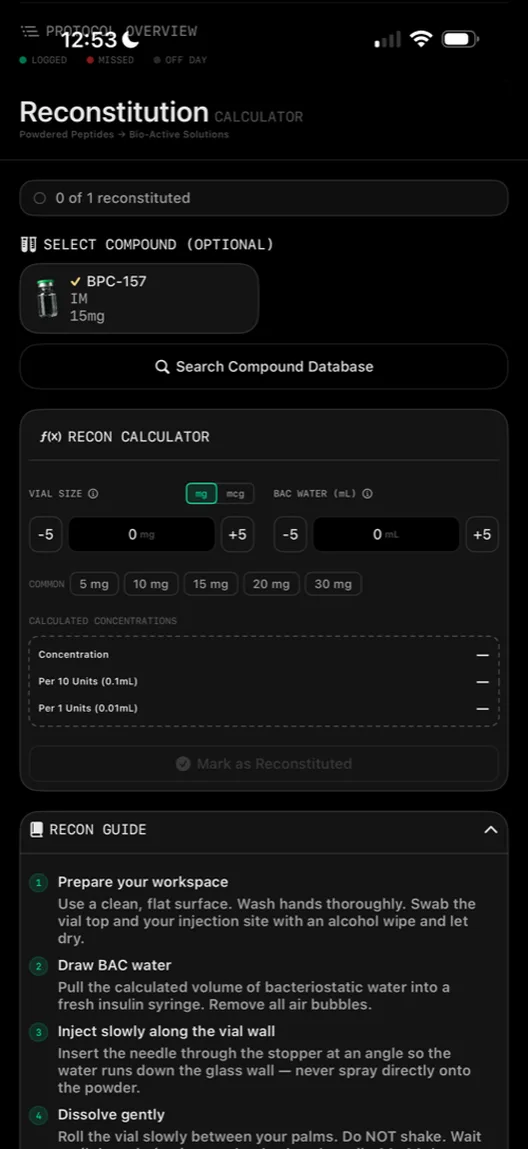
Reconstitution is the step where the diluent choice is made, and it is the step people get wrong most often. The volume of water added determines the concentration, which determines how many units you draw for a given dose. That relationship is arithmetic and it is worth doing rather than estimating: see the peptide dosage and reconstitution calculator, or the per-compound guides such as BPC-157 and semaglutide, which carry the vial sizes each compound actually ships in.
Related terms: reconstitution, lyophilized, insulin syringe.
Sources
- Bacteriostatic Water for Injection, USP: product labeling, DailyMed, U.S. National Library of Medicine.
- Sterile Water for Injection, USP: product labeling, DailyMed, U.S. National Library of Medicine.
- Injection Safety: Questions about multi-dose vials, Centers for Disease Control and Prevention.
- Pharmaceutical Quality Resources, U.S. Food and Drug Administration.