How to read insulin syringe units without guessing.
The barrel is marked in insulin units, not millilitres. For a peptide those numbers mean volume and nothing else, and the difference is where the tenfold mistakes live.
On a U-100 insulin syringe, one unit is 0.01 mL. That is the whole conversion, and almost every mistake people make with these syringes comes from not having it.
The barrel is not marked in millilitres. It is marked in insulin units, because the syringe was designed for insulin, where the concentration is fixed and the units on the barrel line up with the units of drug. A peptide is not insulin, its concentration is whatever you made it, and the numbers on the barrel mean volume and nothing else.
What U-100 means
U-100 is a concentration: 100 units per millilitre. It is printed on the syringe because insulin is sold at that strength, and it is the reason the maths works out so cleanly. A full 1 mL barrel holds 100 units. Half a millilitre is 50. One unit is one hundredth of a millilitre.
The Institute for Safe Medication Practices records the failure mode directly: doses measured in millilitres instead of units, syringe markings misread, and the difference between an insulin syringe and other parenteral syringes not understood. U-100 has also been read as meaning 100 units in the vial rather than 100 units per millilitre. Every one of those is a tenfold class of error.
The three barrel sizes
| Barrel | Holds | Usually marked every | Best for |
|---|---|---|---|
| 0.3 mL | 30 units | 1 unit | Small doses, easiest to read |
| 0.5 mL | 50 units | 1 unit | Mid range |
| 1.0 mL | 100 units | 2 units | Larger volumes, coarsest scale |
Marking intervals vary between manufacturers. Read the barrel you are holding rather than assuming, because a 1 mL barrel marked every 2 units makes an odd number a judgement call rather than a line.
The practical consequence: a smaller barrel is more accurate for a small volume, because the same distance on the plastic represents less liquid. If your draw is 8 units, a 0.3 mL syringe puts that at a quarter of the barrel with a line for every unit. On a 1 mL syringe it is 8% of the barrel between two marks.
Turning a dose into units
Two numbers give you the third. Concentration is how much peptide is in each millilitre, which you set when you reconstituted the vial. Dose is how much you intend to take. Volume is what you draw.
Take a 5 mg vial reconstituted with 2 mL. That is 2500 mcg per mL. A 250 mcg dose is a tenth of a millilitre, which is 10 units on the barrel. Change the diluent to 1 mL and the same vial is 5000 mcg per mL, the same 250 mcg dose is 0.05 mL, and now it is 5 units.
The dose did not change. The number you draw to did, because the concentration did. This is why a unit count copied from someone else's protocol is meaningless without their reconstitution, and it is the single most common way people take the wrong amount.
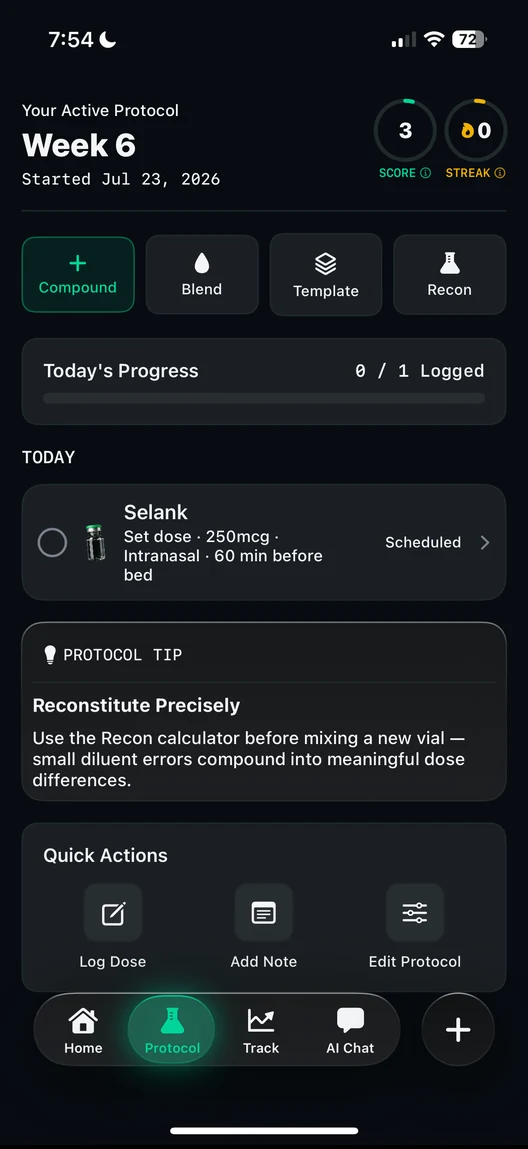
Our reconstitution calculator does this conversion, and it exists because the arithmetic is easy to get right once and easy to get wrong at 6am. Check it against your own working rather than instead of it.
Reading the barrel without guessing
Read at the top ring of the plunger seal, the flat edge nearest the needle, not the domed tip and not the rubber's lower edge. Hold the syringe at eye level: looked at from above or below, the line you think you are on is not the line you are on.
Air is the other half of it. A bubble occupies volume the scale counts as drug, so a syringe drawn to 10 units with a bubble in it holds less than 10 units of liquid. Draw slightly past your mark, tap the bubbles up to the needle, push them out, then bring the plunger back to the number you want.
What this article cannot tell you
It cannot tell you your dose. It converts a dose you already have into a volume on a barrel, and that is a different question from whether the dose is right for you. For most research peptides there is no established human dose to look up, which is a fact about the evidence rather than a gap in this article.
Sources
- ISMP Guidelines for Optimizing Safe Subcutaneous Insulin Use in Adults, Institute for Safe Medication Practices.
- Medication errors during insulin administration, Institute for Safe Medication Practices.
- Syringe Recall: Cardinal Health, Monoject U-100 Insulin Syringe, U.S. Food and Drug Administration.
- Reconstitution calculator, PeptideAI.