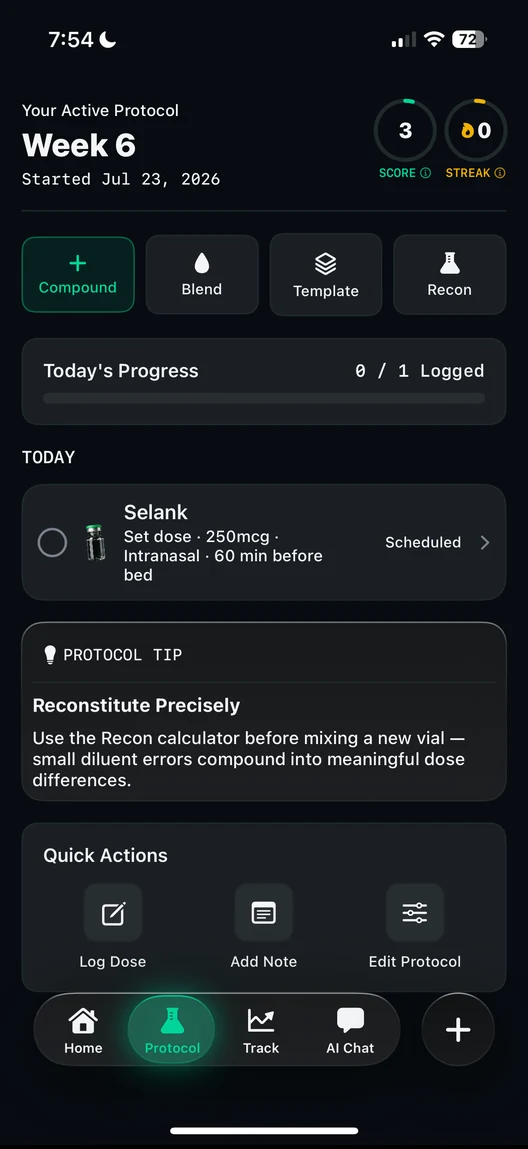
Why your peptide dose looks so small.
Because a microgram is a millionth of a gram, and almost everything you can see in the barrel is water you added yourself.
Because you are injecting a few thousandths of a gram dissolved in water, and the water is most of what you see. A 250 mcg dose is a quarter of a milligram. Reconstituted at a typical concentration it comes out around a tenth of a millilitre, which on an insulin syringe is a barely visible sliver near the bottom of the barrel.
That is the correct amount. The instinct that it looks too small to be doing anything is the instinct worth ignoring here, and the one that leads people to draw more.
The units are doing the work
Peptides are dosed in micrograms far more often than in milligrams. A microgram is a thousandth of a milligram, and a milligram is a thousandth of a gram. So a 250 mcg dose is 0.00025 grams of actual peptide.
Compare that to something you have a feel for. A standard 500 mg paracetamol tablet is two thousand times the mass of a 250 mcg peptide dose. The visual expectation people bring from swallowing tablets is off by three orders of magnitude before they start.
What sets the volume
The peptide contributes almost nothing to the volume. The diluent is the volume. That means you choose it.
A 5 mg vial reconstituted with 1 mL is 5000 mcg per mL, and a 250 mcg dose is 0.05 mL, 5 units on a U-100 barrel. The same vial reconstituted with 3 mL is 1667 mcg per mL, and the same dose is 0.15 mL, 15 units. Three times the liquid, the same quantity of peptide.
Which is why people using more diluent report an easier draw. They have not changed their dose. They have spread it through more water so the measurement lands on a part of the barrel they can actually read. That is a legitimate reason to pick a larger reconstitution volume, and it is often a better one than matching a number someone posted.
When small becomes a problem
There is a floor. Below roughly 4 or 5 units on a U-100 syringe, the error from where you stopped the plunger becomes large relative to the dose. A one unit misread on a 20 unit draw is a 5% error. The same misread on a 4 unit draw is 25%.
If your maths keeps landing under 5 units, the fix is not more care. It is reconstituting with more diluent next time so the same dose occupies more barrel, or using a 0.3 mL syringe where every unit has its own line.
The volume is not a quality signal
Two vials at the same labelled strength, reconstituted differently, produce different draws. Neither is stronger. People compare unit counts across protocols and conclude one source is more potent, when the only thing that differed was how much water went in.
What actually determines what is in the vial is what the vial contained before you added anything, and that is a question about the supplier and their certificate of analysis, not about how the syringe looks.
For most research peptides there is no established human dose, and a number circulating in a protocol is not the same thing as evidence. We label all 57 compounds in the app with how much research exists behind each, including where the honest answer is very little.
The short version
Micrograms are tiny, the diluent is the visible part, and you set the diluent. If the draw is too small to read, reconstitute with more water or use a smaller barrel. Do not draw more to make it look right.
Sources
- How to read insulin syringe units, PeptideAI.
- Reconstitution calculator, PeptideAI.
- ISMP Guidelines for Optimizing Safe Subcutaneous Insulin Use in Adults, Institute for Safe Medication Practices.